Mini Split Refrigerant Leak Repair in Cupertino, CA
Losing cooling and suspect a leak? Call 03092388562 for mini split refrigerant leak repair Cupertino, CA. Same day visits when the schedule allows. Tell us the brand, the sound you hear and whether you see oil or ice. We repair leaks on ductless air conditioner and heat pump systems in Cupertino homes, ADUs and converted garages, ZIP 95014.
A mini split is a sealed system, and Carrier says refrigerant is not a fuel and does not get used up. A unit that runs low has a leak, and a leak can come from wear and tear or poor installation, according to Trane. Adding gas without finding the leak only refills a system that keeps leaking. We find the leak, fix that spot and charge the system by weight.
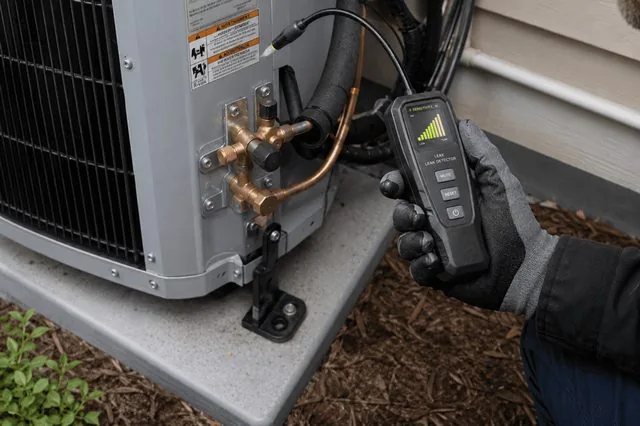
Refrigerant work in the U.S. must be done by a technician certified under EPA Section 608. California HVAC contractors hold a C-20 license, and you can look up any license on the CSLB website.
Mini split refrigerant leak repair: what we do
A leak repair has five jobs. We find the leak, fix that spot, pressure test the repair, pull a deep vacuum and charge the system by weight. The vacuum removes air and moisture, and charging by weight puts back the amount the maker specifies.
Where do mini splits usually leak?
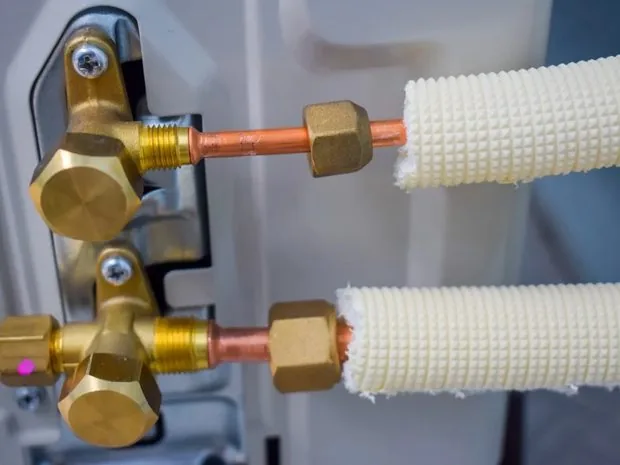
A leak can start in a few places. Trane points to the flare fittings on the refrigerant lines that join the outdoor unit to the indoor units.
| Where it leaks | What goes wrong | How we fix it |
|---|---|---|
| Flare connection at the indoor or outdoor unit | A poorly made flare or a loose fitting | Tighten or remake the flare and torque the nut to the maker’s spec |
| Copper line set | Wear and tear, damage or poor installation on the line | Repair the connection or replace the damaged section |
| Service valve and valve core | A Schrader core that seeps | Replace the valve core and retest |
| Indoor coil | Pinholes from formicary corrosion | Replace the coil |
Formicary corrosion pits the copper of an indoor coil, and contaminants in indoor air can drive it, according to ACHR News.
Evaporator coil leak: when the indoor unit is the source
The evaporator coil sits inside the indoor unit, and a pinhole there can mean a coil replacement. Before anyone talks about replacing a coil, we confirm the leak with a nitrogen pressure test.
Air conditioner refrigerant leak repair for ductless systems
A mini split is a ductless air conditioner, and many are heat pumps that also heat in winter. We repair leaks on single zone and multi zone systems, wall heads and ceiling cassettes. On a multi zone system we test every joint on the run, not only the one near the noise.
Air conditioner coolant leak repair: is coolant the same as refrigerant?
Homeowners often say coolant. In a mini split the fluid that leaks is refrigerant, so the repair is the job described above.
Freon leak repair: is it the same job?
Freon is a trademark owned by Chemours, and it is also used as a general word for a family of halocarbon products, according to Wikipedia. When you say freon, we hear refrigerant, and the work is the same: find the leak, fix it and charge by weight.
Mini split refrigerant: which type does your unit use?
Check the data plate on the outdoor unit. Newer mini splits use R-32 or R-454B, depending on the maker. Lennox says mini splits built after January 1, 2025 use R-32, and Mitsubishi Electric Trane says its new low GWP products use R-454B. Both are A2L refrigerants, which have lower flammability. An older system may use R-410A, and Trane says a system on a phased out refrigerant may be worth replacing. Ask about refrigerant type before you approve a repair on an older unit. We charge only the refrigerant on your nameplate.
What to do if you think your mini split has a leak
These steps are safe for any homeowner. Do them in this order.
Listen. A loud, steady hiss means a fast leak. Turn the unit off and call.
Look for ice. If the indoor coil or the lines are icing, turn cooling off and run fan only until the ice melts. Melting ice can overflow the drain pan.
Look at the pipe joints. An oily film at a flare nut or valve can mark a leak. Do not touch or loosen it.
Take photos. Capture any error code or flashing lights, the model label and any oily spot.
Write down your last recharge. Note when it was and who did it. A unit that keeps losing refrigerant after recharges has a leak that was never found.
Do not add refrigerant yourself. EPA Section 608 certification covers anyone who adds or removes refrigerant, and Trane says only a trained HVAC technician can find the leak, repair it and recharge the system.
Stop and call us if you see any of these
| What you see | What it can mean | What to do |
|---|---|---|
| A loud, steady hiss | An active leak, according to Carrier | Turn the unit off and call |
| Ice on the coil or lines, or ice that comes back after it melts | Trane says a frozen coil can come from a leak or from dirt and dirty filters | Turn cooling off, run fan only until the ice melts, then call |
| An oily film at a pipe joint or valve | A possible leak at that joint | Do not touch or loosen it. Take a photo and call |
| Cooling that keeps getting weaker | Low refrigerant, which Trane says is caused by a leak | Call for a leak search |
| A unit that already needed a recharge once | A leak that was never found | Ask for a full leak search and a nitrogen pressure test |
How a refrigerant leak repair visit works
You call and describe it. Brand, model, any error code, the sound, and whether the unit was recharged before.
We check the basics. Filter, airflow, settings and error codes, so a simple fault is not mistaken for a leak.
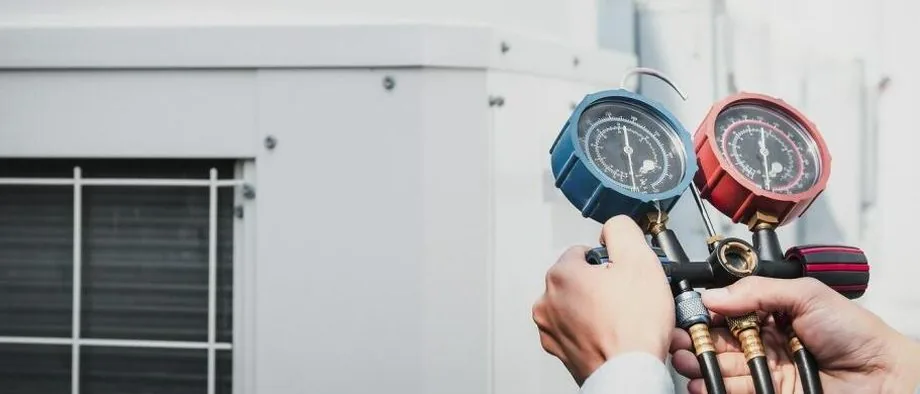
We read the pressures. Manifold gauges, superheat and subcooling readings show whether the charge is low. A low charge sends us looking for the leak.
We find the leak. We use an electronic leak detector, bubble solution on the flare nuts and service ports, and UV dye when the leak hides.
You get the price before work starts. You get a written estimate and upfront pricing.
We fix the leak. We remake a flare, replace a valve core, repair a line set section or replace a coil. We recover the refrigerant first and never vent it.
We pressure test and pull a deep vacuum. Dry nitrogen proves the repair holds, then the vacuum pump removes air and moisture.
We charge by weight and test. We weigh in the nameplate amount, plus any extra the maker specifies for a long line set. Then we run the unit and check the air and the pressures before we leave.
A diagnostic fee applies.
What you can expect from us
- A licensed, EPA 608 certified technician at your door.
- A plain answer on where the leak is and what it takes to fix it.
- We service Mitsubishi, Daikin, Fujitsu, LG, Samsung and MrCool units.
Why a mini split leak hurts in Cupertino homes
The City of Cupertino says the city has about 260 sunny days a year, and Wikipedia describes warm to hot, dry summers. That means long cooling hours, so a leak is felt fast.
Some Cupertino homes have no attic. The Fairgrove tract has 220 to 229 Eichler homes, and Eichlers generally have no attics, with low pitched or flat roofs. Rancho Rinconada has low cost single story homes that Stern & Price built from around 1950 to 1953 to designs by architect Cliff May, according to Wikipedia. In homes like these a mini split can be the main cooling, so a leak leaves no backup.
ADUs and converted garages often run on one mini split sized to the room, so a leak leaves that room with no cooling.
Areas we cover in Cupertino, CA 95014
If you are in one of these areas, call 03092388562 and we will tell you when we can come.
Mini split leak questions
Does a mini split lose refrigerant over time?
No. The refrigerant circuit is sealed, and refrigerant is not used up in normal running. If your unit is low, it has a leak. We find where it is and fix that spot.
Is it safe to keep running a leaking mini split?
Not for long. Turn it off if you hear a loud hiss or see ice, and call. Trane says a system struggles when refrigerant is low, so do not wait on a unit that keeps losing cooling.
Can I add refrigerant to my mini split myself?
No. EPA Section 608 certification covers anyone who adds or removes refrigerant, and a recharge only refills a system that still leaks. We find the leak first, then charge by weight.
Why does my mini split keep losing refrigerant after recharges?
The leak was never found and fixed. Ask for a full leak search and a nitrogen pressure test before any more refrigerant goes in.
Should I repair or replace a leaking mini split?
It depends on the unit’s age, where the leak is and what the repair costs. Trane says to weigh the system’s age, how severe the problem is and whether it uses a phased out refrigerant.
How do professionals find a leak in a mini split?
Trane lists an electronic leak detector and bubble testing, then recovering the refrigerant and fixing the leak. We also run a nitrogen pressure test, and use UV dye when the leak hides.
What are the signs of a leak in a mini split?
Carrier and Trane both list a hissing sound and ice on the coil. Cooling that keeps getting weaker is another sign. If you notice any of these, turn the unit off and call.
Get your mini split sealed and charged right
Do not keep topping off a unit that leaks. Call 03092388562 for mini split refrigerant leak repair Cupertino, CA with your brand and what you see. We will tell you what to switch off, what to photograph and when we can come. Serving Cupertino, CA 95014.
Request a callback
Prefer not to call? Send the form and we will get back to you.